A Definitive Guide to Jian Kiln and the Art of Matcha
In the grand tapestry of Chinese ceramic history, the Jian Kiln (建窑) holds a position of singular, somber elegance. While other kilns vied for the translucent purity of jade, the artisans of Jian-yang sought the depth of the night sky. For the modern connoisseur of UK home interior design and the practitioner of Zen home rituals, the Jian Zhan (Jian teacup) represents the pinnacle of functional art—a vessel that doesn't just hold tea, but transforms it.
LANN Home
4/16/20263 min read
Origins and the Song Dynasty Zenith
The roots of Jian Kiln reach back to the Tang Dynasty, but its true cultural ascension occurred during the Song Dynasty (960–1279 AD). Located in the Fujian province, the Jian kilns specialized in black-glazed stoneware, a stark departure from the celadons of the North.
The rise of Jian ceramics was inextricably linked to the Song Dynasty’s sophisticated tea culture. It was an era where "Tea Contests" (Dou Cha) were the height of scholarly and imperial leisure. The Emperor Huizong, a renowned artist and tea mystic himself, was a devoted patron of Jian ware, asserting that the heavy, dark vessels from Jian-yang were the only suitable companions for the finest whisked teas.
The Alchemy of Iron and Fire
What makes Jian ware—often referred to as Tenmoku (天目) in international circles—so distinctive? The secret lies in the high-iron content of both the local clay and the glaze.
1. The "Heavy" Aesthetic
Unlike the ethereal lightness of porcelain, Jian ware is thick, dense, and grounded. This "heaviness" is a core tenet of the Eastern aesthetic home; it provides a sense of permanence and "Wabi-sabi" honesty that balances the ephemeral nature of a tea session.
2. The Miracle of the Glaze
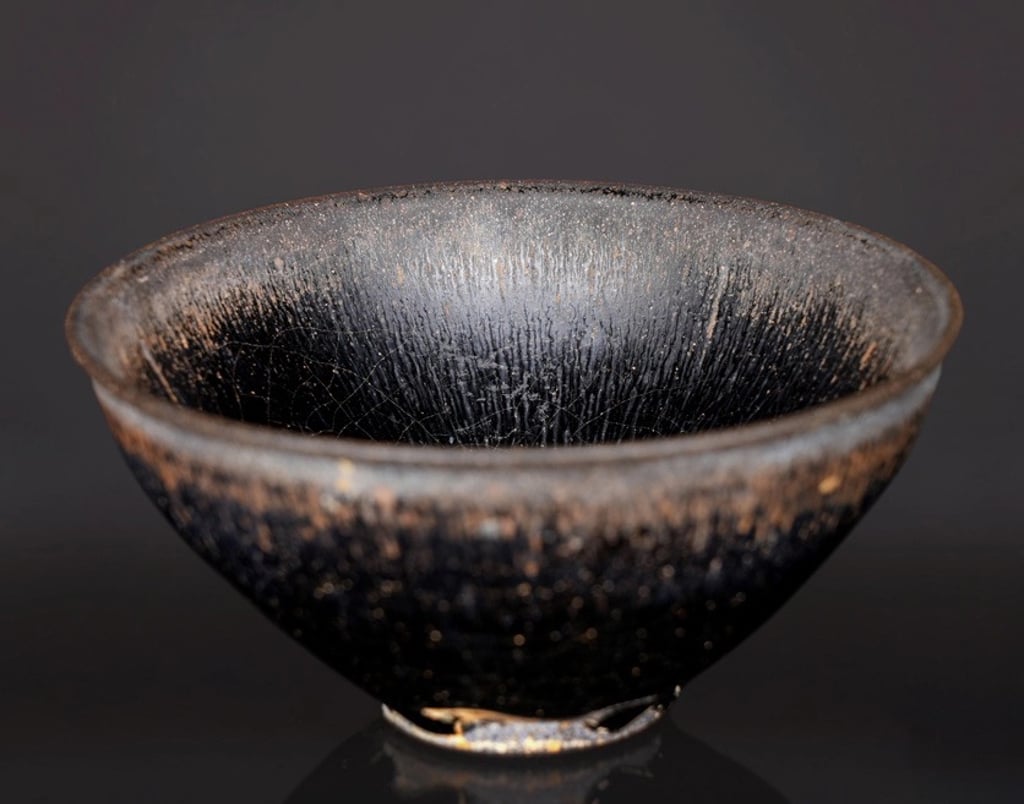
Through precise control of kiln temperatures (reaching upwards of 1300°C) and the cooling process, the iron oxide in the glaze crystallizes into breathtaking patterns. These are not painted; they are "grown" in the fire:
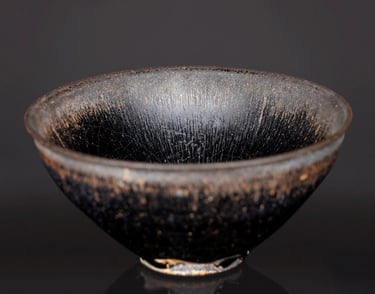
Hare’s Fur (兔毫): Delicate, radiating streaks that resemble the fine fur of a rabbit.
Oil Spot (油滴): Shimmering, circular spots that look like oil droplets on water or stars in a nebula.
Partridge Spot (鹧鸪斑): Mottled patterns echoing the plumage of a forest bird.
Why Jian Zhan is the Supreme Vessel for Matcha
While many admire Jian ware for its beauty, its true genius is functional. To understand why it is the best tool for Matcha, one must look at the physics of the whisked tea ritual.
1. Thermal Inertia and Temperature Retention
Matcha requires water at a specific temperature (usually around 80°C). Because Jian Zhan is crafted from thick, iron-rich stoneware, it possesses incredible thermal inertia. Once pre-heated, the cup retains heat far longer than thin porcelain or glass. This ensures that the matcha remains at the optimal drinking temperature, allowing the complex umami notes to develop fully without the tea turning cold and bitter.
2. The Contrast of Colors: "The White Foam"
During the Song Dynasty, tea was whisked into a thick, white froth—much like modern Matcha. The deep, black glaze of the Jian Zhan provides the ultimate visual contrast. The "Electric Green" of high-quality Matcha pops against the dark, crystalline glaze, turning the act of drinking into a visual meditation. This contrast is a fundamental element of Zen home interior design, where light and dark are used to create focus.
3. The Ergonomics of the Whisk
The classic "Conical" (Funnel) shape of a Jian Zhan is not merely for show. The wide mouth and tapering base allow for the bamboo whisk (Chasen) to move freely and vigorously, creating the micro-foam essential for a creamy Matcha texture. The weight of the base ensures the cup remains stable on the tea mat during this high-energy process.
4. Improving the "Water Quality"
Practitioners of traditional tea ceremonies believe that the iron-rich clay of the Jian Kiln actually "softens" the water. The porous nature of the stoneware and its mineral composition are said to react with the tea’s tannins, smoothing the astringency and enhancing the sweetness of the Matcha.
Jian Kiln in Contemporary British Interiors
For the UK home interior design market, Jian ware offers a bridge between heritage and modernity. Its dark, metallic luster fits perfectly into the Japandi trend—a fusion of Scandi-functionality and Japanese rusticism.
In a London apartment characterized by clean lines and neutral palettes, a single Jian Zhan on a wooden plinth serves as a "living" sculpture. It breaks the monotony of industrial surfaces with its organic, crystalline depth. It is a piece that demands the viewer to slow down—the very essence of a Zen home interior.
LANN Home
Join our journey to discover the art of living.
Contact
Newsletter
© 2026 LANN Home. All rights reserved.
No.65 Huandongyi Road, Jinshan District, Shanghai
Address